


It was supposed to be a breakout week for the Bitcoin price. Macro conditions have shifted toward optimism. After a day of positive net Bitcoin ETF inflows on Tuesday, the trend has been reversed.
The US government is set to reopen after weeks of political deadlock. Treasury yields have edged down, and equity markets are flush with capital.
Yet, rather than surging alongside traditional assets, the Bitcoin price remains subdued, even as billions pour into ETFs across the board.
According to Bloomberg senior ETF analyst Eric Balchunas, the scale of ETF inflows this month has been nothing short of “intense.”
In an X post on November 11, Balchunas highlighted that US-listed ETFs attracted one of their strongest waves of capital in 2025.

This was fueled primarily by “boomer” investors doubling down on broad equity exposure despite growing media chatter about a “stock market bubble.”
ETF data show record-setting inflows into S&P 500 and technology funds, with total US ETF assets nearing $10.5 trillion.
Bitcoin ETF News: Half a Billion in, Then Out Again
Bitcoin ETFs joined the wave early in the week. Spot Bitcoin ETFs collectively absorbed around $500 million in net inflows on November 11, according to Farside Investors.
BlackRock’s iShares Bitcoin Trust (IBIT) led that charge with an estimated $243 million of fresh capital, followed by Fidelity’s Wise Origin Fund (FBTC) and ARK 21Shares Bitcoin ETF (ARKB), each seeing healthy double-digit inflows.
But by November 12, the direction flipped. Daily Bitcoin ETF outflows at midweek were running close to $300 million, reversing nearly half of those prior gains.
Fidelity’s fund saw the sharpest withdrawals, marking one of its largest single-day outflow events since August.
Meanwhile, Ethereum ETFs continued their weak streak. They recorded 10 consecutive sessions of negative flows totaling almost $1 billion this month.
That was despite the Treasury guidance on crypto ETFs opening the door to staking. ETH price struggles to hold above $3,500.
Despite these mixed flows, traditional ETF demand remains firm. “Boomers are saving y’all’s asses (and you know it’s true don’t even argue),” commented Balchunas.
This resilience has helped drive the S&P 500 to fresh highs, but the Bitcoin price has lagged conspicuously behind.
And that’s a pattern that’s raising questions across both retail and institutional trading desks.
The Disconnect Between Flows and Bitcoin Price
The Bitcoin price has barely moved, still clinging above $100,000 by its fingernails even as the macro setup aligns.
Fidelity’s VP Research, Chris Kuiper, pointed out the paradox, addressing the “who’s selling?” mystery.
The likely culprits, he argues, are long-term holders (those who accumulated Bitcoin in prior cycles and are now gradually offloading). Glassnode metrics back this up.
The share of BTC supply active for at least one year has been trending lower, but unlike previous cycles, the decline is shallow.
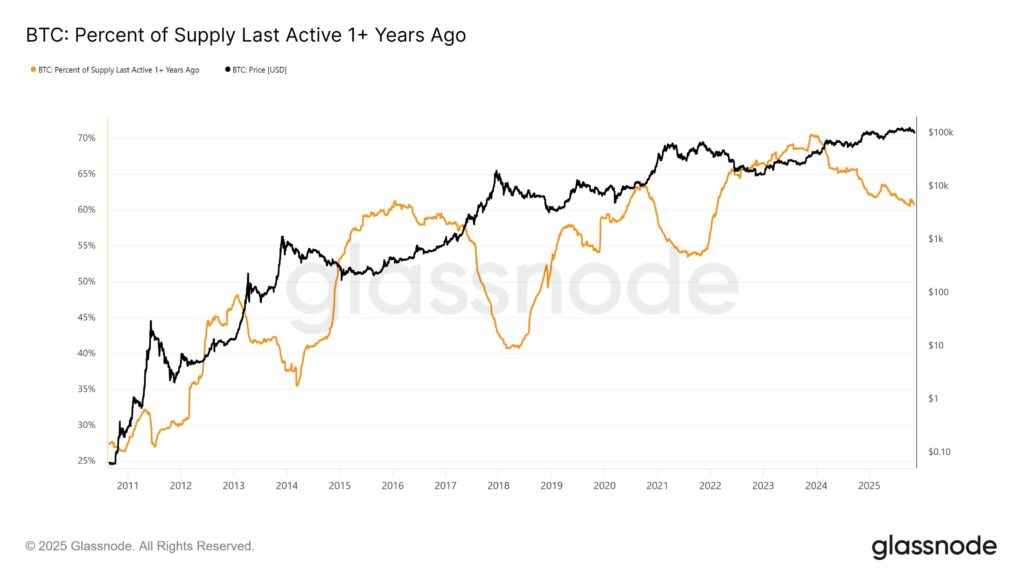
Kuiper explained:
“What is interesting with this cycle is the relatively gentle slope down with this bull market. It didn’t plunge when new highs were made. It’s a consistent slow bleed as the market has slowly moved sideways and up.”
Bitcoin Fatigue Meets Macro Optimism
Year to date, the Bitcoin price is up roughly 15%, but that’s well below gold’s 60% rally and short of the S&P 500’s gains.
For many institutional traders, that relative weakness is surprising given the favorable macro tailwinds.
The US government shutdown resolution, easing Treasury rates, and renewed stimulus prospects all point to a supportive risk environment.
Still, Bitcoin hasn’t responded as theory suggests. Kuiper interprets this divergence not as structural weakness but as part of a maturing cycle. He said:
“I will be watching this slope along with some other metrics to gauge seller exhaustion, but for now the positive fundamental developments and lackluster price action continue to diverge in my opinion.”
Watching for Seller Exhaustion
The key to reversing the current malaise lies in seller exhaustion. The market’s subdued reaction highlights a unique point in Bitcoin’s evolution.
That is a tightening link with traditional capital flows, but persistent sell pressure on the Bitcoin price from legacy holders.
Until those legacy holders finish exiting (and the Bitcoin ETF bid gets more time to build), Bitcoin’s breakout may stay on ice, even as Wall Street’s ETF party rolls on at record pace.