Key Insights
- Bitcoin price USD stayed below $80,000 as macro pressure persisted.
- Glassnode placed major overhead supply between $83,000 and $86,000.
- Friday’s U.S. payroll report could reset Federal Reserve expectations.
Bitcoin price USD held near $77,200 on Sept. 3 after its late-August recovery failed to establish support above $80,000.
BTC traded around $77,200 across major market feeds, remaining inside the range formed after the August short squeeze. Elevated Treasury yields, heavier profitable supply, and weaker ETF turnover continued to restrict the recovery.
Traders are also preparing for the U.S. August Employment Situation report on Sept. 4. The release could alter interest-rate expectations ahead of the Federal Reserve’s Sept. 15–16 meeting.
Bitcoin Price USD Holds Below $80,000
CoinMarketCap showed Bitcoin near $77,200, with roughly $27.7 billion in 24-hour trading volume. The asset remained below the $80,000 level that capped several recent recovery attempts. Its market capitalization stood near $1.55 trillion based on circulating supply.
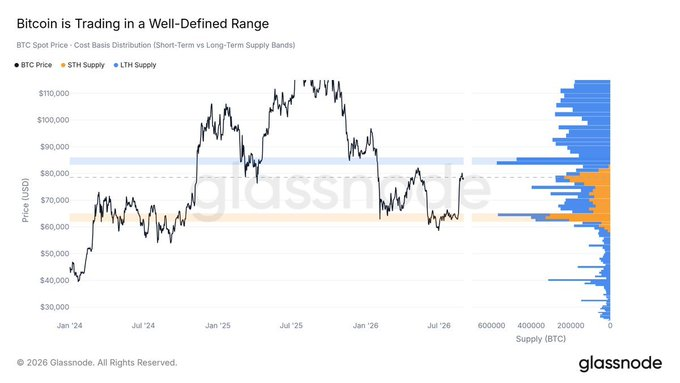
Glassnode researcher Frederik Theissen said the mid-August short squeeze carried Bitcoin into the $80,000 region. The rally then stalled beneath long-term holder supply concentrated between $83,000 and $86,000. Bitcoin later retreated as traders reduced exposure after the squeeze.
Theissen also said spot Bitcoin exchange-traded funds absorbed about $290 million daily at their peak. Secondary-market turnover remained near $3 billion per day during that period. Glassnode described that activity as weaker than prior expansion phases.
Bitcoin Price USD Faces Heavy Overhead Supply
Glassnode data showed 68% of Bitcoin supply in profit near late-August prices. That compared with 65% when Bitcoin traded around similar levels in May. The higher profitable supply increased the pool of coins available for potential selling.
The firm placed Bitcoin’s short-term holder cost basis near $71,000 after summer accumulation. It identified $62,000 to $65,000 as the main accumulation floor below spot. Overhead, long-term holder supply between $83,000 and $86,000 remained the primary resistance band.
Options positioning also reinforced the range. Glassnode said Sept. 25 expiries across Deribit and BlackRock’s iShares Bitcoin Trust carried about $14 billion in open interest. A large share of that positioning sat above $80,000, creating another reference point for volatility.
U.S. Labor Data Adds Pressure to Bitcoin Price USD
The U.S. Bureau of Labor Statistics reported 5.1 million hires and 5.1 million separations in July. More detailed figures showed hires near 5.05 million and separations near 5.07 million. The gap pointed to weak net job creation ahead of the August payroll report.
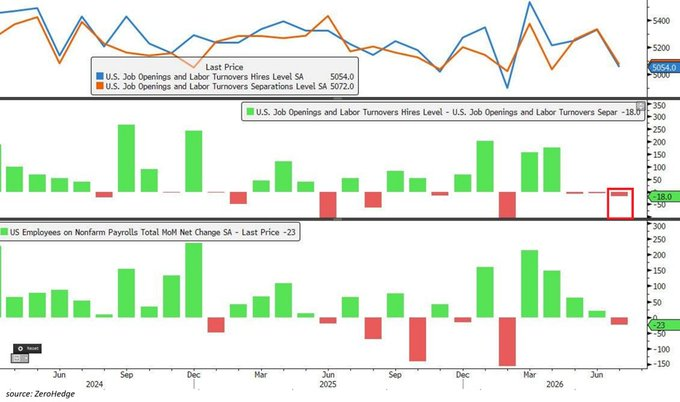
Detailed Job Openings and Labor Turnover Survey figures sharpened that weakness. Hires fell by 278,000 from June, while separations declined by 265,000. That left separations 18,000 above hires. The imbalance widened from roughly 5,000 in June.
The Bureau also reported that nonfarm payrolls fell by 23,000 in July. May and June payroll gains were revised lower by a combined 103,000 jobs. The August Employment Situation report was scheduled for Sept. 4 at 8:30 a.m. Eastern Time.
U.S. Treasury data added another constraint for risk assets. The 10-year Treasury yield stood at 4.79% on Sept. 2. Higher sovereign yields raise the relative appeal of fixed-income assets while increasing borrowing costs across markets.
Glassnode also tracked a rapid reversal in sovereign yields after the Aug. 19 Treasury buyback announcement. The 10-year yield briefly approached 4.6% before returning toward 4.8% within eight trading sessions. That reversal tightened financial conditions during Bitcoin’s failed recovery above $80,000.
Bitcoin Price Today Tracks Gold More Closely
Grayscale Head of Research Zach Pandl said Bitcoin’s 90-day Nasdaq 100 correlation fell to about 33%. The measure had previously stood above 60%, according to Grayscale Institute. Bitcoin’s gold correlation rose above 50% from near zero earlier this year.
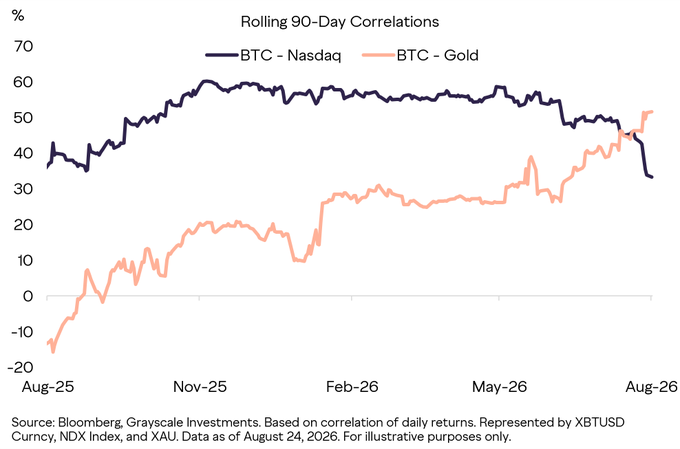
That shift separated Bitcoin from the technology-heavy equity trade that dominated much of the prior year. Grayscale linked the move to renewed investor focus on scarce assets amid persistent deficits and rising debt costs. The correlation shift remained backward-looking and did not guarantee future price behavior.
Federal Reserve policy remained another near-term catalyst. The Federal Open Market Committee scheduled its next meeting for Sept. 15–16. CME FedWatch tracks rate probabilities through 30-day federal funds futures, keeping labor data central to policy expectations.
The next test arrives with the U.S. August jobs report on Sept. 4. A weaker payroll print could reshape rate expectations before the Federal Reserve meeting. Bitcoin faces $83,000–$86,000 resistance, while $62,000–$65,000 remains the main downside support zone.
This article is for informational purposes only and does not constitute financial advice. Cryptocurrency markets can experience sharp price movements.