


Key insights:
- Stablecoin news centers on U.S. Bank’s live cross-border USBDC payment pilot.
- The bank used Stellar to connect the payment to its internal infrastructure.
- The bank also plans separate dollar and euro stablecoins for launch in 2026 and 2027.
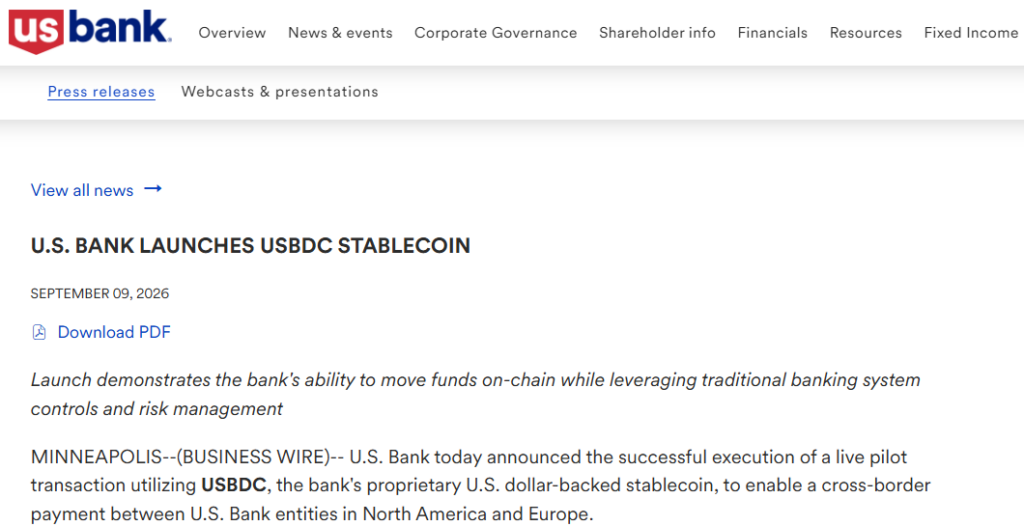
U.S. Bank has completed a live cross-border payment using its proprietary dollar-backed USBDC stablecoin. The transaction moved funds between U.S. Bank entities in North America and Europe. It also tested how USBDC payments can operate alongside the bank’s existing financial and operational systems. U.S. Bank conducted the transaction on the public Stellar blockchain.
Notably, the pilot connected blockchain settlement with the bank’s finance, risk, compliance, and operations infrastructure. That structure allowed U.S. Bank to transfer value on-chain without separating the transaction from its internal controls.
Stablecoin News: Core Controls for USBDC Payments
Meanwhile, the trial evaluated several functions required for managing a bank-issued digital asset. The features included minting USBDC, processing payments, and redeeming the stablecoin. In the pilot, U.S. Bank also piloted freezing and clawback controls.
It used its in-house-built Digital Asset Platform to support those operations. The platform provides the technical foundation for issuing, managing, and transferring tokenized assets. It further connects legacy banking infrastructure with supported blockchain networks.
Additionally, U.S. Bank presented USBDC as one of the first bank-issued stablecoins deployed on a public blockchain. The bank said the structure could support transactions throughout the day, including outside conventional banking hours.
Chief Executive Officer Gunjan Kedia reported that the pilot tested faster global cash management and money movement. She also linked the transaction to the bank’s use of blockchain technology within its established banking framework.
Stellar Supports the Live Transaction
The transaction also extends U.S. Bank’s existing relationship with the Stellar Development Foundation. Stellar supplied the public blockchain infrastructure used to complete the payment between the bank’s regional entities.
Building on that test, U.S. Bank is examining several institutional applications for the technology. These include liquidity management, collateral mobility, cross-border treasury operations, and other settlement processes.
Jamie Walker, U.S. Bank’s head of digital assets and money movement, described the pilot as part of its wider digital asset strategy. He reported that the bank focuses on client use cases while maintaining its established safety, security, and reliability requirements.
However, USBDC payments form part of a wider shift among major international banks. Reuters reported that Goldman Sachs, Bank of America, Citigroup, and Wells Fargo joined plans for a separate dollar stablecoin.
Those banks plan to create a company in 2026 to manage the project. The group expects to issue its dollar-pegged cryptocurrency during the first half of 2027.
Moreover, the group first announced the initiative in October 2025 with ten participating banks. It also plans stablecoins linked to other Group of Seven currencies, with the euro listed as a priority.
Stablecoin News Draws Regulatory Scrutiny
Elsewhere, another consortium of 37 financial institutions has formed a company called Qivalis. Reuters reported that Qivalis plans to launch a euro-backed stablecoin later in 2026.
Some financial institutions participate in both projects. Spanish bank BBVA, for example, belongs to the dollar-focused group and the Qivalis consortium. World Liberty Financial, President Donald Trump’s family crypto business, has also issued a separate stablecoin.
At the same time, European Central Bank President Christine Lagarde has raised concerns about privately issued stablecoins. She said they could affect monetary policy and financial stability without strong regulatory frameworks.
She reported that unbacked crypto assets grew from below €200 billion in early 2020 to around €2.7 trillion in 2025.
Lagarde also linked that expansion to investor speculation and extreme price volatility. She said those characteristics make unbacked assets unsuitable as reliable payment instruments and expose investors to financial risks.