
Key Insights:
- XRP Ledger XLS-75 innovation improves permission delegation by closing security gaps found during V1.0 testing.
- XRP Ledger and Claude AI connect through formal verification work aimed at proving key ledger functions work as expected.
- The lending protocol will support institutional credit, including working capital and trade finance use cases.
XRP Ledger developer J. Ayo Akinyele has highlighted how the XLS-75 innovation makes permission delegation safer, after a major security issue was found during testing before the feature reached the XRPL mainnet. V1.1 keeps the feature intact while adding fixes for delegate checks and multi-signing.
XRP Ledger Update: XLS-75 Gets A Safer Path To Mainnet
Akinyele explained that Permission Delegation allows one account to act for another, but only within the permissions given by the account owner. The feature can help users and custody providers let another account handle selected actions without giving it full control.
Because delegation changes how transactions are processed, security was a major concern. During V1.0 testing, a critical vulnerability was reported through the bug bounty program before the amendment reached the XRP Ledger mainnet.
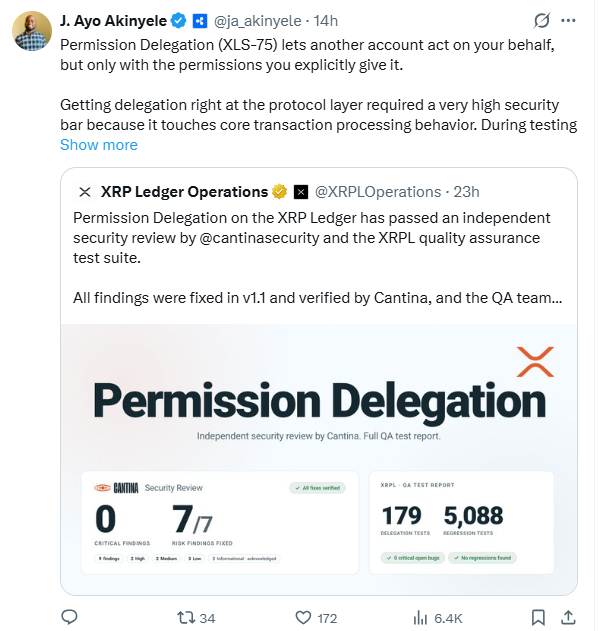
Instead of only patching the issue, the team pulled the amendment and introduced V1.1. This creates a clear line between the first version and the hardened release, while giving developers a safer base for the XRP Ledger XLS-75 innovation.
V1.1 closes gaps around delegate identity and prevents newer features, including Vault and Lending operations, from being delegated by mistake. It also fixes reserve accounting for delegated payments.
The update further closes a multi-signing path that could bypass delegation checks. Revocation behavior was tightened, and the team tested delegation more broadly against other ledger functions.
The core purpose of XLS-75 remains unchanged. The update is meant to make the capability safer to activate. That is important because permission delegation gives another account room to act, making clear limits and checks a key part of the feature.
XRP Ledger And The Claude AI Verification Push
The wider work on the XRP Ledger also includes formal verification. XRPL contributor Mayukha Vadari said the team is working with Common Prefix to mathematically check important parts of the ledger.
The work follows the same type of formal methods recently used with Claude AI to formalize Fermat’s Last Theorem. The goal is to prove that critical parts of the system behave as expected, rather than relying only on regular testing.
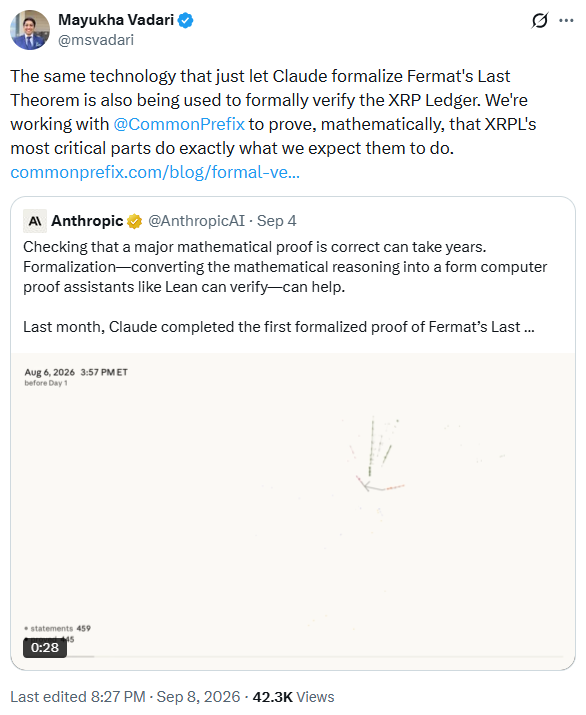
This gives the XRP Ledger and the correlation tech with Claude AI a clear connection through formal verification. For a network handling payments, accounts, and new financial tools, deeper checks can help reduce the chance of hidden problems.
The approach also fits with the decision to pull XLS-75 after the V1.0 vulnerability was found. Both efforts point to more testing before important changes are activated.
Insight Into The XRPL Lending Protocol
XRP Ledger is also preparing for native lending through XLS-66. Cicada Credit is taking the role of Loan Broker in the upcoming protocol, with a focus on institutional credit.
Cicada handles borrower sourcing, credit checks, risk management, covenants, and monitoring off-chain. Meanwhile, the protocol handles loan issuance, fixed terms, interest, repayments, and defaults on-chain.
The model differs from many crypto lending systems that rely on over-collateralized loans. The discussion instead focuses on real business needs, including working capital and trade finance.
One example involves a stablecoin issuer waiting for a traditional fiat wire. The firm could use the pending receivable as collateral, borrow RLUSD on-chain, and repay the loan when the wire arrives.
The lending plan also connects with Single Asset Vaults under XLS-65. These tools point to a wider push to bring practical credit activity onto the XRP Ledger.
For the XRP Ledger, the wider message is that new features are being tested not just for what they can do, but for how they behave alongside existing rules. That matters as more institutional tools are brought onto the network and before wider use.
XRP price remains separate from these protocol changes, but the developments show that work around the XRP Ledger goes beyond payments. Security, formal checks, and lending are being developed together, with the aim of making the network more useful while protecting its core rules.