

Key Insights:
- Blockchain news: The US SEC proposes blockchain-based ownership records for tokenized stocks.
- The plan could reduce duplicate records and reconciliation issues.
- Transfer agents would still maintain required control and transfer records.
The latest blockchain news features the U.S. Securities and Exchange Commission, which proposed to modernize its long-standing transfer-agent rules earlier this September.
The SEC’s press release announced that the update would “reflect transfer agents’ current processes and operations, including the use of … blockchain technology in connection with securities offerings and the transfer of shares.”
Blockchain News: On-Chain Registers and Tokenized Stocks
Under the draft rule, a transfer agent could maintain its master securityholder file on a blockchain. The SEC’s proposal would allow electronic databases, including blockchain ledgers, to serve as the official record of securities ownership.
In practical terms, this would allow a properly governed blockchain ledger to replace the parallel off-chain shareholder register that tokenized stocks now maintain. If approved, “a blockchain could become the ‘master security file,’ replacing the parallel off-chain ownership records that tokenized securities often still rely on today.”
Current practice keeps two records: the on-chain token ledger and the traditional register maintained by a transfer agent. Lawyers today default to the latter as the legal owner of a share. Under the SEC’s proposal, the blockchain could become the authoritative source, eliminating the need for costly reconciliation.
The proposed change could eliminate duplicate off-chain shareholder records, reducing the need for reconciliation and helping clarify legal ownership for tokenized securities.
The SEC said the proposed amendments are intended to modernize transfer-agent rules for electronic and blockchain-based records while preserving required controls and records.
Even with blockchain registers, tokenized stocks would remain subject to securities laws. Wall Street’s blockchain news coverage highlights that transfer agents would still enforce rules like ownership eligibility and handle mailings, dividends, and inheritances.
Notably, the proposal would recognize blockchain wallet addresses as valid securityholder contact information. But using blockchain does not mean open-access tokens: identity checks and transfer restrictions would remain “built into the token” under any on-chain system.
Industry Momentum and Next Steps
This move aligns with broader industry trends. On Sept. 10, Nasdaq announced that its venture arm will invest $100 million in Payward (Kraken’s parent) to expand tokenized stock infrastructure.
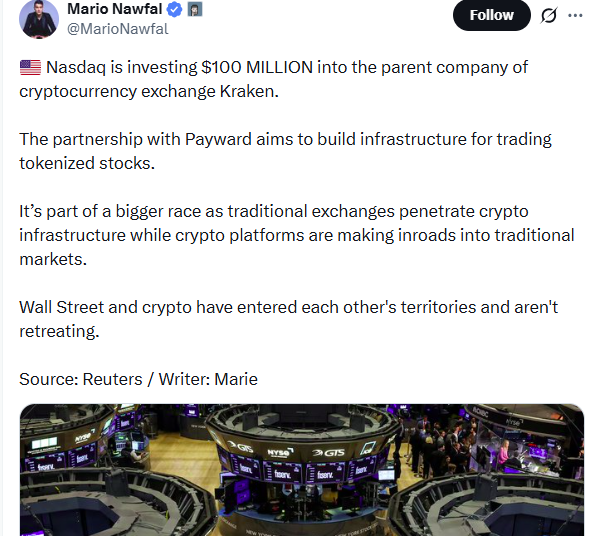
Nasdaq noted that its funding will support “Nasdaq Equity Tokens” on Payward’s xStocks platform, with trading expected by mid-2027.
Formal SEC rulemaking will follow the public comment period. The agency’s press release said comments will remain open for 60 days after the Federal Register publication.