


Key Insights
- Anthropic stock struggled to join Monday’s artificial intelligence sector rebound.
- Shares remained above their offering price despite Friday’s sharp reversal.
- Open-weight competition and new leveraged funds complicated the early trading picture.
Anthropic stock fluctuated around $88 in New York on Monday, Nov. 23, as competing artificial intelligence shares rallied. Jensen Huang’s return to Nvidia raised fresh questions about competition with the Claude developer.
The divergence mattered because Anthropic had joined Nasdaq only days earlier. Investors were already assessing its valuation, future computing costs, and exposure to alternative AI models.
Anthropic Stock Trades Near Its Offering Price
Bloomberg’s morning market snapshot placed Anthropic shares at $88.29 at 10:08 a.m. Eastern. That left the stock about 6.4% above its initial public offering price, despite fluctuating between gains and losses.
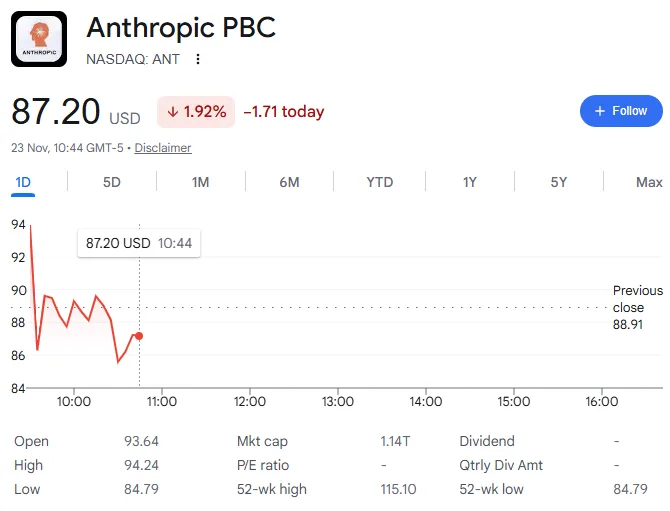
Anthropic’s investor-relations data showed shares had closed Friday at $88.91, down 8.5% that session. The stock had approached $83.05 during Friday’s decline, almost erasing its opening-week premium.
TradingView data placed Thursday’s first-session high at $115.10, demonstrating the range investors had already faced. Its short trading history limited the usefulness of conventional chart-based support or resistance indicators.
Yahoo Finance historical prices recorded an opening trade at $111.50 and a first-day close of $97.17. Those early reversals showed that selling pressure developed before Monday’s leadership announcement.
Associated Press market coverage showed the Nasdaq Composite gaining 6.8% around 10:15 a.m. Monday. Anthropic’s early trading therefore diverged from a broader rebound across technology shares.
Anthropic confirmed its Class A shares began trading under ANT on Nov. 19. The company completed its offering the following day after underwriters exercised their additional share option.
The company’s announcement put gross offering proceeds near $93.5 billion, with roughly $91.6 billion going to Anthropic. Those proceeds provided funding, but they did not establish a sustainable earnings outlook.
Open-Weight Debate Puts Anthropic Stock Under Scrutiny
Nvidia announced Monday that its directors unanimously reinstated Huang as chief executive, president, and board member. The company said its board had consulted senior U.S. government officials before reaching its decision.
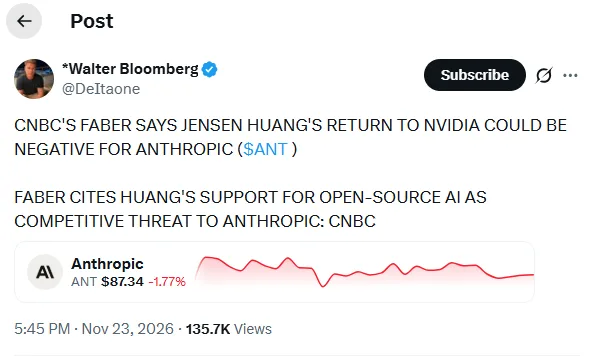
Huang had previously supported wider access to AI model weights, a policy distinct from Anthropic’s proprietary approach. A July industry letter carrying Nvidia’s signature argued that downloadable models could strengthen competition and lower deployment costs.
Anthropic’s Securities and Exchange Commission prospectus acknowledged potential competition from open-weight and open-source systems. The filing warned that such alternatives could attract cost-conscious customers and exert pressure on prices.
The prospectus also identified Google and OpenAI as direct competitors for enterprise customers and computing resources. It cautioned that other providers could integrate AI services into existing products and distribution channels.
Anthropic also warned that limited access to affordable computing capacity could constrain its model development. The filing said competition could increasingly depend on infrastructure access rather than model capabilities alone.
MarketWatch cited Gabelli Funds analyst Ryuta Makino describing Huang’s return as potentially unfavorable for frontier AI laboratories. That assessment reflected competitive positioning, not proof that leadership news caused Anthropic’s early share movements.
Nvidia’s relationship with Anthropic also complicated a simple rivalry narrative. Anthropic disclosed that Nvidia joined several technology companies in a separate $26 billion private placement alongside the offering.
The arrangement gave Anthropic additional capital from companies involved in supplying chips, cloud services, and related infrastructure. It also connected its financing structure with firms pursuing their own AI strategies.
New Trading Products Expand Anthropic Stock Exposure
Tradr announced Monday that its long and short exchange-traded funds began trading on Cboe. The ANTT fund targets twice the stock’s daily return, while ANTZ targets twice its inverse daily return.
Cboe’s listing records confirmed both products carried a Nov. 23 listing date. Their daily-reset design makes their returns different from simply holding or shorting ordinary shares over longer periods.
Tradr’s prospectus described leverage, derivatives, and the possibility of investors losing their principal. The issuer advised active monitoring because daily performance targets do not extend reliably across multiple sessions.
These products add trading choices without demonstrating stronger institutional demand for the underlying company. Fund launches alone reveal little about investors’ eventual positioning or trading volume. This article provides market information, not investment advice.
The connections extended into tokenized securities markets. Securitize announced that it had made Anthropic-linked stock exposure available through its Solana-based platform on listing day.
The firm’s announcement described an expansion of tokenized U.S. equities offered to eligible investors. This created another distribution channel without establishing a direct link between crypto trading and Monday’s stock performance.
The next U.S. trading session falls on Tuesday, Nov. 24. Investors can compare Anthropic stock’s performance with the wider AI sector and examine trading in the new funds.