

- White House review tops CFTC news as states challenge sports contracts in court.
- A coalition of 44 attorneys general opposes the CFTC’s prediction market proposal.
- New Jersey asks the Supreme Court to decide who can regulate sports contracts.
The latest CFTC news puts prediction market rules before the White House as states challenge sports contracts in court. The Commodity Futures Trading Commission sent the proposal to the Office of Management and Budget for regulatory review.
The proposal in the CFTC news addresses which event contracts exchanges under the commission’s oversight can list. New Jersey has asked the U.S. Supreme Court to hear a dispute over who regulates those contracts.
CFTC News and What the White House Is Reviewing
The Office of Management and Budget listed the proposal under the title “Prediction Markets; Public Interest Determinations.” Its Office of Information and Regulatory Affairs reviews federal regulations before publication.
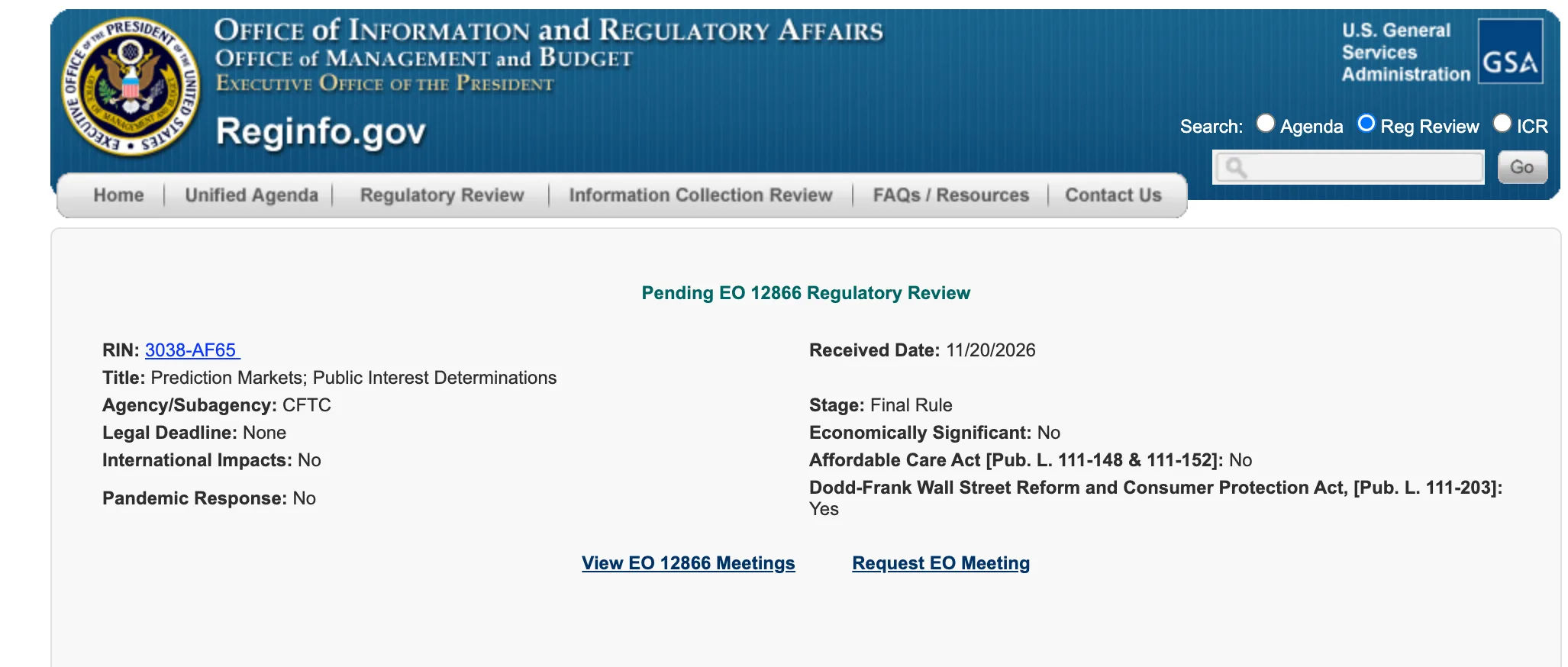
The filing says CFTC staff are considering rule changes to clarify the regulatory framework for event contracts. Staff also want to provide market participants with greater certainty about which rules apply.
The commission proposed the rules in June as prediction market trading grew to a billion-dollar scale. The public docket drew more than 1,300 comments on that proposal.
The June proposal outlined restrictions on event contracts tied to gaming, war, terrorism, and assassination. Under the proposal, exchanges could list only contracts that meet the commission’s public-interest requirements.
The proposal on CFTC news also addresses how the commission would decide whether an event contract involves gaming. The proposed definition centers on games of chance such as poker.
Under that approach, some sports contracts could continue trading on exchanges under the commission’s oversight. Those sports contracts are also the subject of challenges from state gambling authorities.
Why Sports Contracts Are at the Center of the Fight
State authorities have sued platforms such as Kalshi and Polymarket to stop them from operating in their jurisdictions.
They argue that the platforms offer sports betting while avoiding state gambling requirements and tax obligations.
The CFTC has filed its own lawsuits against states to assert federal authority over the platforms. The litigation has involved nearly a dozen states, and courts have reached conflicting conclusions.
Under Chair Michael Selig, the commission has asserted “exclusive jurisdiction” over event contracts. It argues that prediction market contracts qualify as swaps because they depend on the outcomes of future events.
The commission says that classification brings the contracts under federal oversight. State authorities maintain that contracts tied to sports fall within their authority to regulate gambling.
What New Jersey Wants the Supreme Court to Decide
Former CFTC Commissioner Christy Goldsmith Romero discussed the conflicting court rulings at the Capitol Crypto Forum on Thursday.
She said those decisions could bring the dispute before the Supreme Court. Romero singled out sports contracts when discussing how the case could end. “I think it’s likely that the prediction markets may end up losing on the sports contracts,” she said.
The latest CFTC news also includes opposition from a coalition of 44 attorneys general. The coalition said on Friday that it opposed the agency’s rulemaking on prediction markets.
New Jersey’s request to the Supreme Court focuses on the jurisdiction dispute behind the lawsuits. The state wants the justices to decide whether the federal government or states have authority over the contracts at issue.
This article provides general financial information, not investment advice. Cryptocurrency prices fluctuate, and technical indicators cannot guarantee future returns. Investors should conduct independent research before making financial decisions.