


Key Insights
- Crypto regulation in France retained existing self-custody wallet reporting rules.
- French senators rejected proposed stablecoin conversion taxes and crypto exit taxes.
- European cryptocurrency transaction reporting obligations remained in place.
Crypto regulation in France faced parliamentary opposition on Nov. 24 after the Senate rejected mandatory crypto wallet disclosure. The proposal targeted self-custody wallets holding assets worth €100,000 or more.
The French Senate also rejected proposals to tax stablecoin conversions and extend exit taxes to cryptocurrencies. Public Accounts Minister David Amiel opposed the amendments during discussions on the 2027 finance bill.
The decisions preserved existing reporting and taxation rules for cryptocurrency investors. However, France continues implementing European tax transparency requirements covering transactions conducted through cryptocurrency service providers.
Crypto Regulation in France: Senate Blocks Wallet Disclosure
Senators Pascal Savoldelli and Pierre Barros submitted amendment I-2447 to modify Article 1649 bis C of France’s General Tax Code. The proposal introduced reporting obligations for taxpayers who controlled cryptocurrency wallets without third-party custodians.
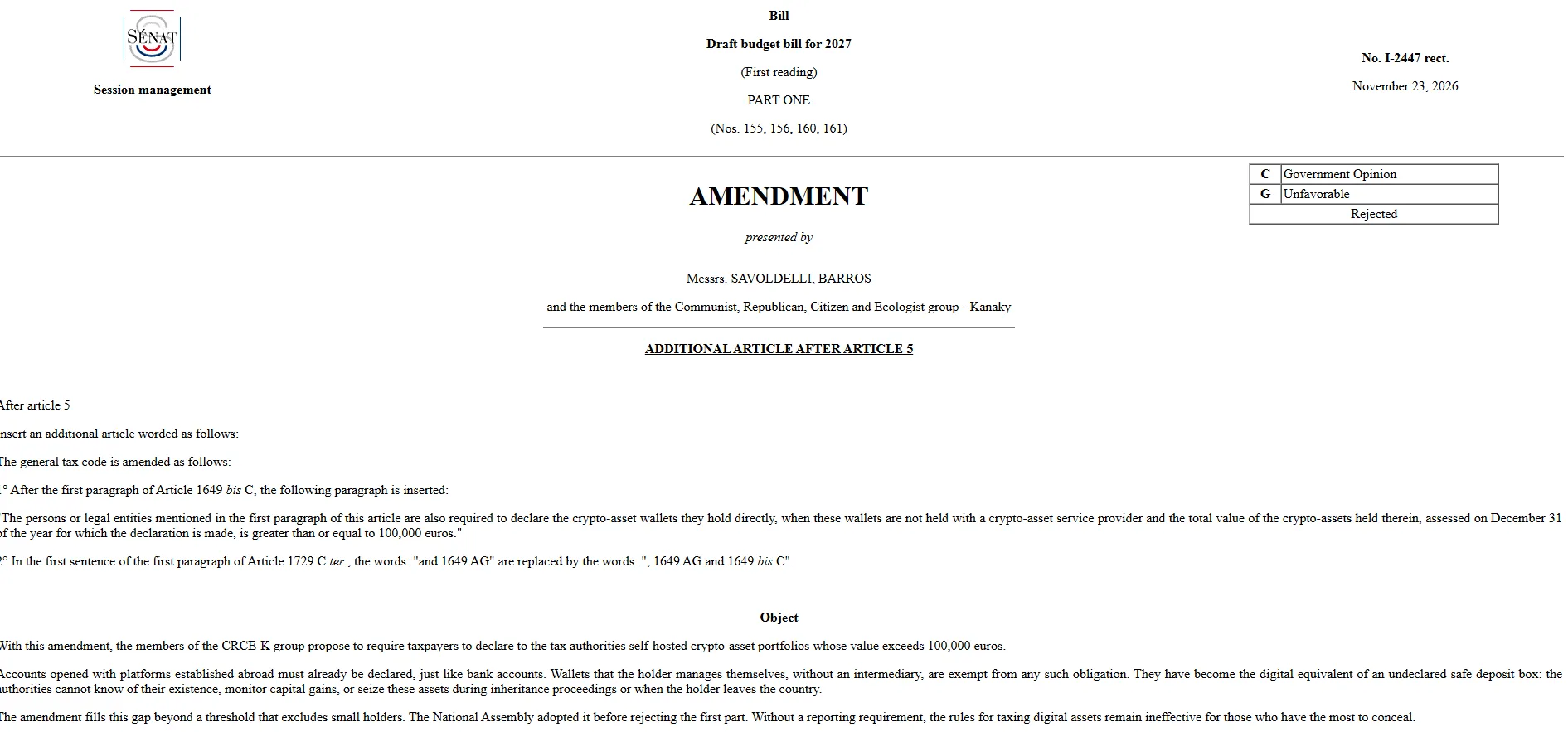
Taxpayers would have calculated the combined value of their cryptocurrency holdings on December 31 each year. Those meeting the specified threshold would have declared their holdings to French tax authorities.
Senator Alexandre Basquin argued that existing legislation treated foreign cryptocurrency accounts differently from self-custody wallets. Taxpayers already report accounts held through overseas cryptocurrency platforms under French tax rules.
Basquin said the amendment sought to address that discrepancy without introducing an additional tax. Its authors also cited difficulties assessing cryptocurrency gains, inheritance obligations and assets held by departing taxpayers.
However, Amiel questioned whether mandatory declarations would improve efforts against money laundering and tax fraud. He pointed to existing European legislation governing cryptocurrency intermediaries.
Senate Finance Committee General Rapporteur Christine Lavarde supported the government’s opposition. Senators subsequently rejected the amendment alongside an identical proposal from another parliamentary group.
The decision followed an earlier vote in the National Assembly. On Nov. 3, deputies approved a similar disclosure proposal with 150 votes in favor and 44 against.
However, the National Assembly subsequently rejected the budget’s revenue section. That procedural outcome prevented the proposed reporting requirement from advancing through the lower chamber.
French Senate Rejects Stablecoin and Crypto Exit Taxes
The Senate also rejected amendment I-2421, which proposed ending tax deferrals for certain stablecoin conversions. The measure specifically targeted electronic money tokens recognized under European cryptocurrency legislation.
Savoldelli argued that investors could retain cryptocurrency gains through stablecoins without triggering immediate taxation. His proposal sought to apply existing capital gains taxation rules to those transactions.
Amiel opposed treating stablecoins as conventional currency, citing their lack of legal tender status. The minister also questioned whether certain stablecoins satisfied appropriate stability requirements.
Meanwhile, amendment I-2428 sought to expand France’s exit tax to cryptocurrency holdings. The proposed rules covered investors who transferred their tax residence outside France.
Lawmakers proposed an aggregate threshold of €800,000 across qualifying securities, equity interests and cryptocurrency holdings. The amendment would have covered assets held through intermediaries and self-custody wallets.
Barros argued that existing exit tax rules created unequal treatment between cryptocurrency investors and traditional securities holders. Both the government and Senate Finance Committee opposed the measure.
The rejected proposals would have applied to qualifying transactions and transfers of tax residence from Jan. 1, 2027.
Crypto Regulation in France Retains Existing Tax Requirements
The French tax administration applies a combined flat tax of 31.4% to private investors’ taxable cryptocurrency gains. That rate comprises 12.8% income tax and 18.6% social contributions.
Investors can alternatively elect progressive income taxation while remaining subject to social contributions. Cryptocurrency exchanges without additional consideration qualify for tax deferral under existing legislation.
The administration also exempts investors whose qualifying annual disposal proceeds do not exceed €305. That exemption applies to gross disposal proceeds rather than net capital gains.
Meanwhile, European cryptocurrency reporting requirements continue under the eighth Directive on Administrative Cooperation (DAC8). The European Commission introduced the framework to strengthen cross-border tax enforcement.
The directive took effect in January 2026, requiring covered cryptocurrency service providers to collect reportable transaction information. European tax authorities will exchange information covering the first reporting year by Sept. 30, 2027.
The framework imposes reporting obligations on intermediaries rather than a general declaration requirement for privately controlled wallet balances. The French Senate’s rejection left that distinction intact.
The next legislative milestone for crypto regulation in France remains the 2027 budget review. The Senate’s parliamentary calendar scheduled revenue discussions through Nov. 28 or 29. Lawmakers scheduled expenditure debates from Nov. 30 through Dec. 9.