Threat Contained, Vulnerability Fixed: LiFi
Blockchain security watch dog Cyvers Alerts reported that cross-chain liquidity API LiFi Protocol suffered an ‘approval exploit’ on Tuesday. ‘More than $8 Million’ drained in the attack. The protocol has since sanitized, LiFi protocol assured users Wednesday.
When Cyvers first tweeted about the attack, the watch dog had estimated a drain of nearly $8 Million. LiFi’s security incident report, which it published today, revealed that $11.6 Million drained.
LiFi’s security incident report stated, “The total amount stolen is estimated to be around $11.6 million. The attack occurred on Ethereum and Arbitrum, impacting 153 wallets. Assets drained included USDC, USDT, and DAI. It is important to note that the vulnerability limited to infinite approvals and did not affect finite approvals, which is the default setting within the LI.FI API, SDK, and widget.”
LiFi protocol tweeted on Wednesday “A smart contract exploit earlier today has contained and the affected smart contract facet disabled. There is currently no further risk to users.”
“The only wallets affected, set to infinite approvals, and represented only a very small number of users.”
Cyvers recommended LiFi protocol users revoke approval for:
0x1231deb6f5749ef6ce6943a275a1d3e7486f4eae
LiFi also warned users soon after Cyves Alerts’ warning to revoke approvals for the following addresses:
0x1231deb6f5749ef6ce6943a275a1d3e7486f4eae
0x341e94069f53234fE6DabeF707aD424830525715
0xDE1E598b81620773454588B85D6b5D4eEC32573e
0x24ca98fB6972F5eE05f0dB00595c7f68D9FaFd68
Defi security specialist Decurity tweeted “The root cause is a possibility of an arbitrary call with user controlled data via `depositToGasZipERC20()` in GasZipFacet which was deployed 5 days ago!”
Users beware of fake X IDs impersonating LiFi Protocol. It’s highly recommended to avoid interacting with the fake IDs, particularly, avoid clicking on any links by these IDs. Please note that the original LiFi X (formerly Twitter) ID is “@lifiprotocol”.
The following image shows an impersonator replying to Decurity’s tweet. In the image, note the X (formerly Twitter) handle of the impersonator; this ID does not represent LiFi protocol. Also, see the link carefully, it says LIFIPROTOCOI (there’s an ‘i’ in the end, not an ‘L’).
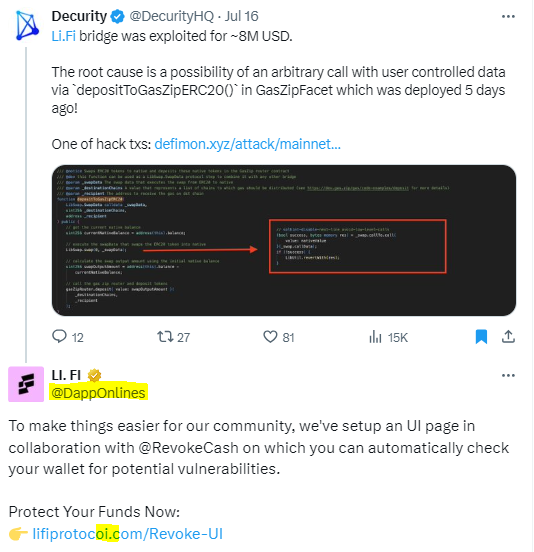
LiFi Explains Attack in Security Incident Report
Regarding the latest attack, LiFi’s noted in its security incident report: “The exploit occurred shortly after a new smart contract facet deployed. A vulnerability in the upgrade allowed the attacker to gain unauthorized access to user wallets within minutes of deployment.”
It added: “The vulnerability stemmed from the fact that callers to the contract were able to make arbitrary calls to any contract without validation. This capability was provided by the LibSwap library, which facilitates making calls to multiple DEXs, fee collectors, and other entities before bridging or sending funds to a user. In all other facets of the LI.FI contract, these calls validated against a whitelist of approved contract addresses and functions. However, caused by an individual human error in overseeing the deployment process, in the case of the new facet, this validation check was missing.”
Peckshield highlighted that Tuesday’s exploit was similar to an attack dated March 20th, 2022. The 2022 attack described and explained in LiFi’s blog. Per the blog, the attacker exploited the swap feature of LiFi’s smart contract. Nearly $600K drained because of that bug.
LiFi uses the swapping feature before the funds are transferred through a bridge. Those users who had set approvals to infinite were vulnerable.