





Key Insights:
- PYTH saw a faster surge than Chainlink price, as LINK’s government integration is broader and slower to impact.
- Open interest fell from $1.91 billion to $1.67 billion, net flows shrank, and the Money Flow Index flattened after early August gains.
- LINK price stayed below key resistance levels, with sentiment improving only gradually compared to PYTH’s hype-driven jump.
Chainlink (LINK) price has been in a broader uptrend, rising 36.2% recently. But in the past 24 hours, LINK gained less than 2%, even after announcing a major integration with the U.S. Commerce Department.
By contrast, Pyth Network (PYTH) revealed a similar deal, and its token surged more than 100% in a single day. This raises the question: why did PYTH’s price explode while LINK’s barely moved?
Different Deals, Different Market Reactions
Both Chainlink and Pyth announced integrations to deliver U.S. government economic data to blockchain applications. But the market treated them very differently.
For PYTH, this was seen as a brand-new breakthrough, something that could transform its role in the data space. Traders rushed in, doubling its price within a day.

However, Chainlink’s announcement was viewed as an extension of what it already does. LINK has been the leading oracle network for years, and the new U.S. Commerce Department data feed was seen as a continuation, not a sudden change.
Because of that, Chainlink price did not get the same kind of reaction, even though the fundamental significance of the deal is strong.
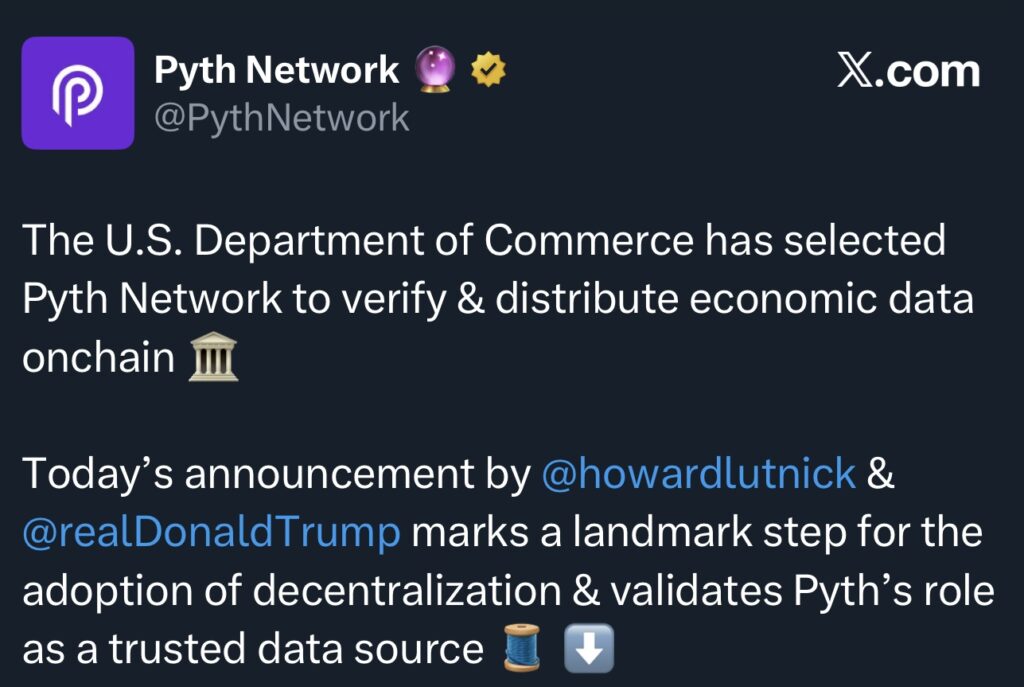
Simply put, PYTH’s announcement read direct. Messages from officials and the project said Pyth Network was selected to verify and distribute U.S. economic data on-chain.
To traders, that looked like “the government picked PYTH.” And that explains the price rise.,
Why Chainlink Price Reaction is Muted?
The slow Chainlink price reaction also shows up in on-chain and trading data.
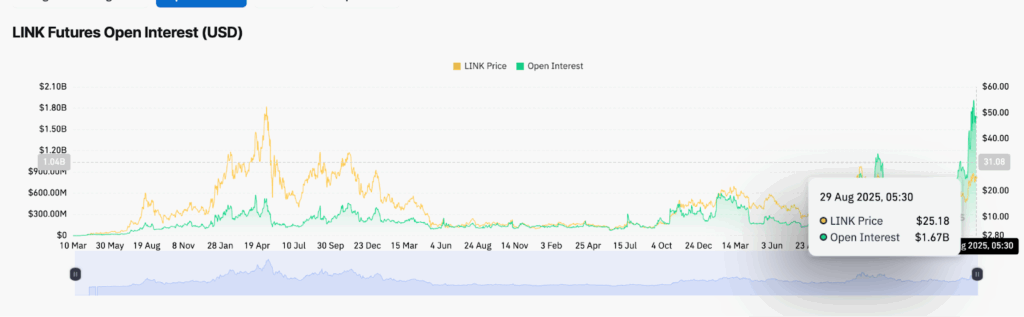
LINK’s open interest in futures contracts dropped from $1.91 billion on August 24 to $1.67 billion by August 27. This means traders reduced their leveraged positions instead of betting heavily on the news.
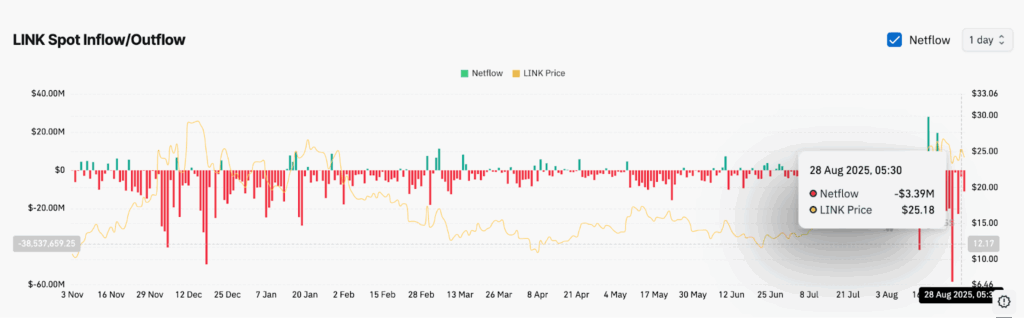
Spot flows tell a similar story. On August 25, LINK recorded strong net buying of $58 million. But that momentum quickly faded. By the next day, net flows had collapsed to just $3.3 million.
Initial excitement gave way to caution, and buyers did not stay engaged.
The Money Flow Index (MFI), a momentum indicator that measures buying and selling pressure using both price and trading volume, showed a similar trend.
MFI had improved earlier in August, rising above 60 from the low 50s, which usually signals that more money is flowing into the asset. But following the U.S. Commerce Department deal, MFI flattened, showing that the inflows lost strength and buying pressure did not accelerate further.
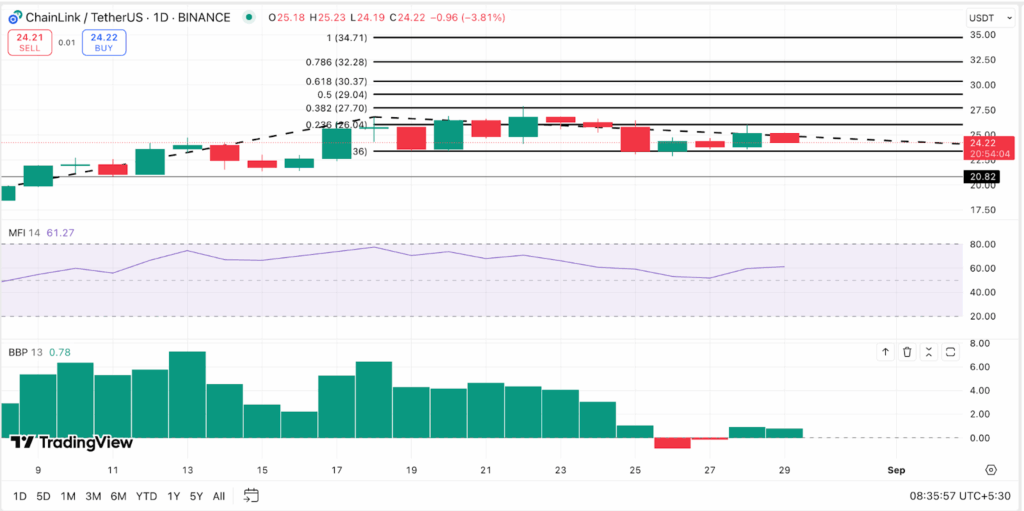
The Bull Bear Power (BBP) indicator, which compares buying to selling strength, also pointed to weakening momentum. While BBP stayed positive, showing that buyers still had some control, the value had been trending lower, a signal that bullish pressure was not as strong as before.
Together, these metrics explain why Chainlink price stayed muted. The fundamentals were positive, but traders did not maintain the same intensity of buying as they did for PYTH.
Chainlink Price Levels To Watch
At press time, Chainlink price was trading at around $23. The key resistance level to watch is $26.04. A daily candle close above that level would confirm that buyers are back in control and could open the door for a stronger LINK rally.
On the downside, $23 is an important support. If LINK breaks below it, selling pressure could increase and put the token at risk of further correction, with $21 being a very strong support level.
For now, Chainlink price is in a range. Its fundamentals remain strong, but unless buying pressure returns, its price may continue to lag behind other projects like PYTH in the short term.




 secured a U.S. Commerce Department data deal, but unlike PYTH, Chainlink price barely moved. Weak money flow explains why the LINK price stayed flat.)