

Key Insights:
- BaFin is the independent Financial Supervisory Authority of Germany, and mandates that every Crypto Payment Gateway register to operate in the country.
- MiCA regulations oversee crypto activities across 27 member states of the EU, including Germany.
- Crypto payments are legal in Germany. However, BaFin doesn’t consider any cryptocurrency as legal tender, including Bitcoin. They treat it as a financial instrument under German banking law.
Germany has emerged as a major destination for crypto payments in Europe despite strict regulations. Merchants have begun accepting Bitcoin, stablecoins, and other digital assets via specialized gateways.
These payment processors offer rapid settlement and protect businesses from revenue losses due to volatility. With the full rollout of MiCA, compliant platforms provide secure, EU-wide solutions.
In 2026, businesses are in a better position with lower transaction costs, instant transaction confirmations, and a seamless integration process. These advantages are driving the adoption of crypto payment methods in e-commerce and retail businesses.
Crypto Regulatory Framework of Germany
Germany has a comprehensive crypto regulatory framework governed by the EU’s MiCA regulations (Markets in Crypto-assets). The Bundesanstalt für Finanzdienstleistungsaufsicht (BaFin) supervises and regulates all financial institutions and enforces compliance.
In 2013, BaFin recognized Bitcoin as a “unit of account” and classified it as a form of “private money” that is a financial instrument. This provides a legal framework where Bitcoin can be traded and taxed legally in Germany. However, it does not confer legal tender status.
MiCA fully enacted on December 30, 2024. It mandated that Crypto-asset service providers (CASPs) comply with BaFin requirements to continue their services. Germany introduced a 12-month deadline for the transition. This offered CASPs going through the process with some ease of mind.
CASPs must comply with AML/KYC and Travel Rule requirements when making crypto transfers. Crypto payment gateways offering custodial and fiat conversion services require CASP approval or EU passporting.
The regulations provide relief to the merchants. Businesses accepting crypto payments for goods don’t require a hold license if they aren’t providing any financial services.
German capital gains rules require businesses to report every crypto settlement. They treat every crypto transaction as a taxable event. As of early 2026, BaFin has approved approximately 18 CASPs, which is more than any other EU member state.
How to set up crypto payment in Germany
Steps to set up crypto payment acceptance in your business:
- Step 1 requires merchants to choose a MiCA-compliant crypto payment gateway.
- Register the account and complete the required KYC. After making the selection, register the account, and complete the KYC.
- Now, integrate the gateway into your website using APIs. Businesses employing WooCommerce, Shopify, or Magento can opt for plugins.
- Then add your preferred payment option at checkout via QR, and your setup is complete. Businesses can also add their wallet addresses.
- The customer sends crypto using their wallet, and the payment gateway confirms the transaction.
- The merchant receives the payment directly in crypto. If the business prefers fiat currency, then the gateway automatically converts the digital currency to EUR, depending on the settings.
5 Major Crypto Payment Gateways in Germany
CoinRemitter
Coinremitter is a Singapore-based crypto payment gateway. Founded in 2017, this platform enables merchants to accept payment in multiple cryptocurrencies. Their free plan supports transactions in 7 digital currencies. The premium tier plan expands it to 11 assets, available at $99.99 per month.
CoinRemitter charges significantly lower processing fees in comparison to its competitors. It takes only 0.23% of the total amount at the time of withdrawal. The platform is a custodial checkout solution and supports auto-withdrawals, invoice generation, and gas station features.
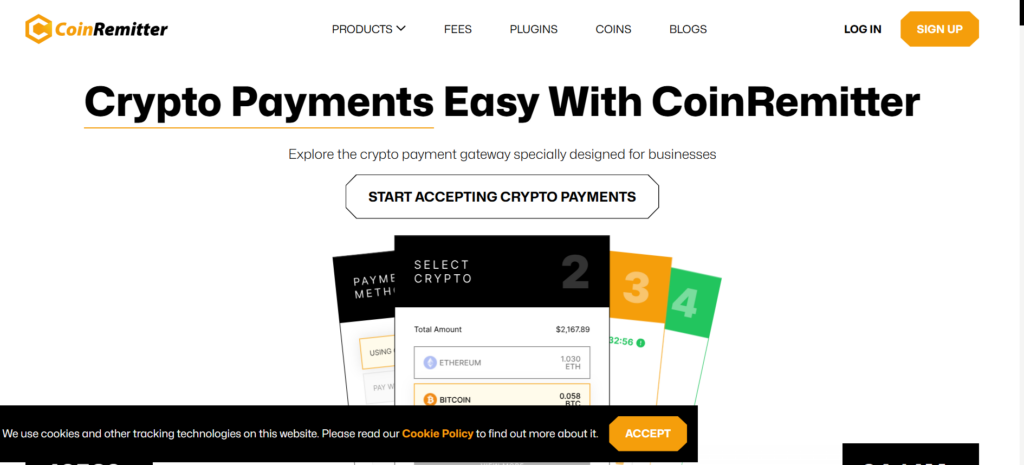
This gas station feature is exclusively available for the premium customers. It reduces the gas fee by up to 40%-50%. Coinremitter also offers open-source plugins for multiple platforms. The names include WooCommerce, Magento 2, and OpenCart.
CoinRemitter has a presence worldwide in over 130+ countries, and requires no mandatory KYC for basic use. In addition to the 0.23% withdrawal fee, the platform also charges network fees separately. The lower charges and ease of use appeal to cost-conscious German merchants seeking affordability and reliability.
Plisio
Pisio is another prominent crypto payment processor founded in 2019 in Manchester, United Kingdom. Incorporated as Plisio Ltd, the founders dissolved the UK entity in 2021. However, it continues to serve as an independent, decentralized cloud infrastructure service, meaning
German businesses use Pisio because of its easy integration and lower gateway fee. Pisio charges only 0.5% processing fee for standard API transactions. Businesses that employ Pisio to process crypto payments natively on their websites pay 1.5%, which is slightly higher than the 1.2% rate.
The platform charges no subscription fee for monthly setup and maintenance. It also features a bulk-in, bulk payout API, which allows over 1,000 transactions at once.
Just like CoinRemitter, Pisio claims to operate as a no-KYC. However, it uses a third-party compliance provider named SumSub. German merchants may face some regulatory hurdles in integrating this gateway, as it isn’t MiCA-compliant.
Confirmo
Daniel Houska and Roman Valihrach founded Confirmo in 2014. These 2 were also involved in creating Coinmate, a cryptocurrency exchange. Based in Prague, Czech Republic, this platform is one of the longest-running crypto payment gateways in the industry.
Unlike CoinRemitter and Pisio, Confirmo is a compliance-first payment processor. It received its first MiCA authorization in December 2025. The Central Bank of Ireland officially granted this license to its Irish group entity, Confirmo Limited.
Confirmo strictly mandates the Know Your Customer (KYC) process for businesses and adheres to Crypto Travel Rule Standards. Under which, identity verification is required when the transfer amount exceeds €1,000. This makes it a perfectly legal and ideal option for German retailers.
It charges 0.8% processing fee for invoice generation and payment acceptance. That is marginally higher per the industry standards. However, it provides businesses with automated exchange risk mitigation. The platform also charges a 0.5% fee on mass payouts, plus a network blockchain fee.
B2BinPay
B2Binpay is an institutional-grade payment processor that operates alongside B2Broker Group. Established in 2014 by fintech entrepreneur Arthur Azizov, it is a crypto payment gateway that provides enterprise and white-label infrastructure. The platform also completely avoids the “no-KYC” retail market.
Tallinn, Estonia, is the base for the firm’s technical and development operations. At the same time, the company utilizes its Italian branch in Rome for business development.
The company complies with strict KYC/AML frameworks. It also operates with on-chain transaction monitoring, also known as Know Your Transaction (KYT), and holds a VASP (Virtual Asset Service Provider) license.
The Financial Service Commission (FSC) of Mauritius issued it under the Virtual Asset and Initial Token Offering Services Act 2021. For the European market, B2BinPay has structured its operations in accordance with EU compliance rules.
However, it still does not hold the MiCA CASP license of its own. The platform provides multiple options for accepting crypto payments and supports over 350 digital assets across 10 blockchains.
B2BinPay operates as a white-label vendor. It enables banks and other payment processors to launch their own crypto payment and wallet stacks. They do this while utilizing BeBinPay’s core engine.
CryptoPay
George Basiladze and Dmitry Gunyashov established CryptoPay, headquartered in London, United Kingdom. The firm has been on the scene since 2013. This makes it a decade-old, and one of Europe’s long-standing, highly regulated crypto payment gateways.
Cryptopay doesn’t have a physical presence in Germany and has no subsidiaries in the country. Still, it possesses a large user base there. It provides services to German merchants and businesses across Europe via its two Baltic corporate entities.
The names include CPS Solutions OÜ (Estonia) and UAB CPS Payments (Lithuania). CryptoPay is licensed as a Virtual Asset Service Provider (VASP) in Estonia and Luxembourg. The firm also holds an MSB (Money Services Business) license in Canada.
Moreover, it is registered with the UK’s HMRC under AML. CryptoPay still does not hold any standalone fully passported MiCA license.
However, it strictly aligns with the EU’s AML, KYC, and Travel Rule frameworks. It bars anonymous transactions and mandates each business entity to clear corporate onboarding.
CryptoPay charges a 1% processing fee on withdrawals while eliminating hidden subscription costs. It facilitates payments across 19+ cryptocurrencies. Merchants get the option to convert the digital assets into 35 fiat currencies.
This saves the fund from volatility, and businesses receive a stable payout in their account via SEPA or wire transfers.
Overall, Germany’s clear MiCA framework favors fully compliant gateways. Merchants should check the current BaFin registers and consult professionals for tailored tax and compliance guidance.