

Key Insights:
- T54 introduced x402 payment tools that allow software agents to handle payments, risk checks, and credit services on the XRP Ledger (XRPL).
- XRP ETFs recorded $10.66 million in net inflows last week, led by Franklin’s XRPZ and Bitwise products.
- Developers outlined five planned XRP Ledger upgrades, including quantum security preparations and native lending features.
XRP Ledger (XRPL) is seeing activity on several fronts as new payment tools go live, XRP ETFs or investment funds record fresh inflows, and developers outline plans aimed at protecting the network from future security risks.
XRP Ledger (XRPL) Adds New Payment Tools For Software Agents
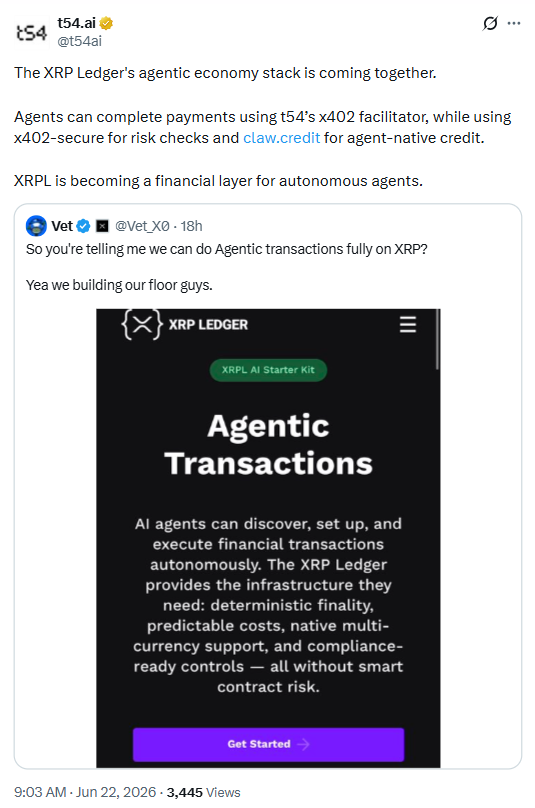
The XRP Ledger is gaining new payment features through a set of tools introduced by T54. The company said software agents can now complete transactions using its x402 facilitator.
The system is built to help automated programs handle payments directly on the network. Alongside the payment service, agents can use x402-secure to carry out risk checks before funds move. This allows a transaction to be reviewed before it is completed.
Another part of the XRPL update is Claw Credit, a service focused on credit access for software agents. The platform is designed to give automated systems a way to use credit within the same environment where payments are processed.
T54 described the setup as a stack that brings payments, risk checks, and credit services together. The company said these parts are being connected on the XRP Ledger so software agents can carry out financial tasks with less human input.
The move reflects a wider push across the digital asset sector to build systems that can handle routine actions on their own. While blockchain networks have mainly been used by people sending and receiving funds, developers are increasingly looking at ways automated programs can interact with those networks as well.
For XRP Ledger, the latest addition is another example of how the network is being used for more than simple transfers. The focus is now expanding to include services that support automated activity.
The update also arrives at a time when many firms are exploring practical uses for software agents in finance. Payment handling, risk review, and credit access are among the areas receiving attention.
By placing those services on the XRP Ledger (XRPL), developers hope to create an environment where automated systems can carry out transactions more easily.
XRP ETF Products Continue To Draw Fresh Capital
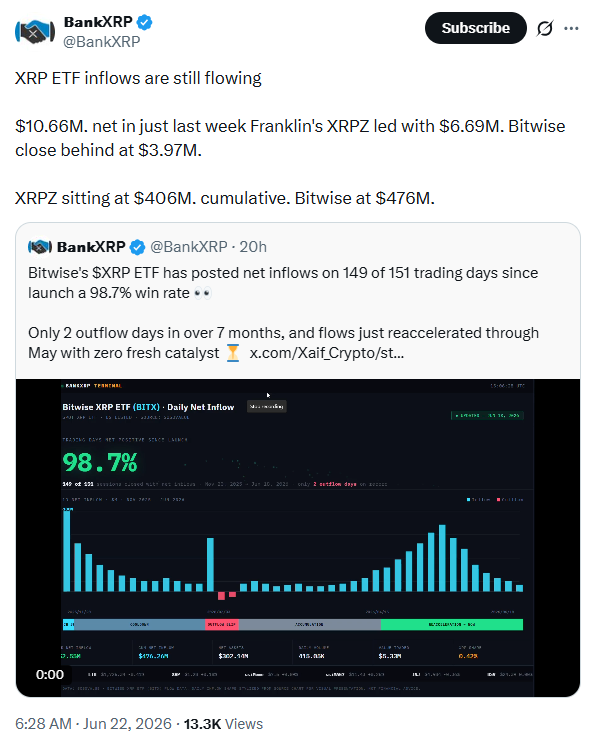
New money is still moving into investment products tied to XRP. Figures shared by BankXRP showed that XRP exchange-traded funds (ETFS) recorded net inflows of $10.66 million during the past week.
Franklin’s XRPZ fund accounted for most of that total after bringing in $6.69 million. Bitwise followed with net inflows of $3.97 million.
The numbers also showed the amount collected over time by both products. XRPZ reached $406 million in cumulative inflows, while the Bitwise fund stood at $476 million.
Amid the XRPL update, the fund flows are also watched closely because they can provide a picture of investor interest. Although weekly totals can rise or fall, positive ETF fund flow shows that money is still entering XRP-related products.
The latest figures arrive as the market continues to track demand for digital asset investment vehicles. They also come during a period when the XRP ecosystem is seeing development activity beyond the investment side of the market.
For supporters of the asset and XRP Ledger (XRPL), the inflow data offers another sign that interest has not disappeared. Market participants will likely continue watching whether that trend remains in place over the coming weeks.
XRP Ledger Maps Out Security And Lending Plans
Work is also continuing on the network itself. BSCN reported that ecosystem validator Vet outlined five upgrades planned for XRP Ledger. The proposals focus on security, network strength, and additional financial services.

One area receiving attention is preparation for future quantum computing risks. Developers are looking at ways to make sure the network can respond if advances in computing create new security concerns.
The roadmap also includes native lending features and improvements aimed at supporting liquidity on the network.
In addition, developers are using AI-based systems to test security under different conditions. Formal verification methods are also being used to check code and reduce the chance of errors.