Key Insights
- SpaceX stock price closed at $139.11 after Citi raised its target to $280 following Starship flight 15.
- Pivotal Research estimated reusable Starship could lower Starlink deployment costs by up to 23 times.
- Citi, Pivotal Research, Raymond James, and Morgan Stanley set targets from $260 to $800.
SpaceX stock price closed at $139.11 on Nov. 13, while Citi raised its target to $280 after Starship Flight 15. The increase followed the bank’s attendance at the Starship Flight test in Starbase, Texas. Citi previously held a $240 target.
During the Nov. 13 session, shares opened at $140.17, reached $142.24, then fell to $136.64. SPCX stock later recovered toward $140 but finished below its open and the previous close of $139.94.
That produced a daily loss of $0.83, or 0.59%, across a $5.60 high-to-low range.
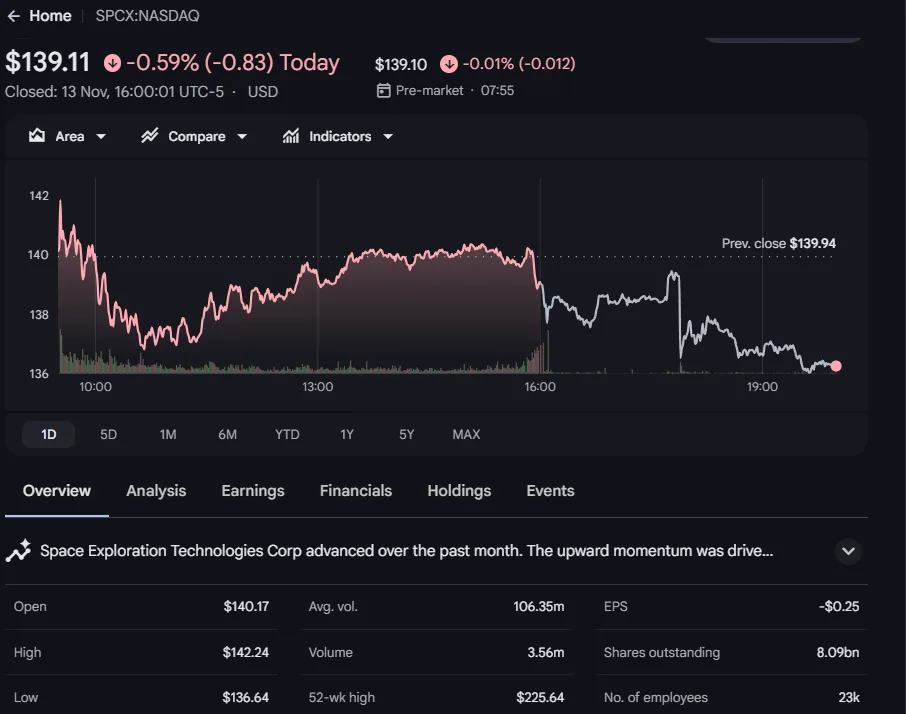
After-hours trading later dipped toward $136, while the displayed premarket quote stood at $139.10. SPCX stock closing price was about 38% below the screenshot’s 52-week high of $225.64, according to Google Finance data.
Starship Flight 15 Shapes Targets and Reuse Estimates
Following the flight test, Citi raised its SpaceX stock price target from $240 to $280. Mechazilla’s launch tower arms caught Ship 42, Starship’s upper stage. Citi had previously identified a successful catch as one of several milestones on SpaceX’s development path.
The bank also increased its 4Q26 and 1H27 revenue and adjusted EBITDA estimates. Those revisions mainly affected the Super Intelligence segment. Citi said discussions with stakeholders and company representatives at Starbase strengthened its conviction in that segment’s outlook.
Its multi-year analysis projected potential upside toward $900 or more. At the Nov. 13 close, Citi’s $280 target represented about 101% upside for SpaceX stock price. Its $900 outlook was approximately 547% above that close.
SpaceX (SPCX) Stock Price to $260?
Pivotal Research also assessed the recovery, giving SPCX stock a Buy rating and a $260 target. It said Ship 42 completed roughly 14 orbits over about 22 hours, deployed 26 Starlink V3 satellites, and survived reentry before the catch.
Pivotal described the event as the first recovery of an orbital-class upper stage. The firm said no recovered Starship had flown twice, leaving repeat reflight untested. It added that the catch demonstrated the hardest recovery step and shifted attention toward how quickly reuse could scale.
Pivotal estimated the fully reusable Starship could reduce Starlink capacity deployment costs by about 23 times. Its comparison put Falcon 9 costs near $6 million per terabit per second, against roughly $250,000 for Starship.
That estimate assumed a $15 million flight and 60 Tbps of capacity. At 26 Tbps, Pivotal estimated costs would still be about ten times lower.
Analysts Update SPCX Stock Targets as Speculation Surfaces
Raymond James gave SPCX stock a Strong Buy rating and an $800 target, alongside a displayed price of $140.54. Its analysis characterized Starship Flight 15 as a major step toward Starship commercialization.
Pivotal estimated the flight at about 22 hours, while Raymond James put it near 22.5 hours; both cited roughly 14 orbits and 26 Starlink V3 satellites.
Raymond James noted that Super Heavy did not return on this flight but cited earlier successful booster catches and reflights. It said SpaceX had recovered both stages independently on separate flights.
The remaining steps included simultaneous recovery, rapid refurbishment, and repeatable reflights. The firm connected Starship’s development with SpaceX’s launch, connectivity, and orbital AI operations.
Earlier SpaceX Stock Price Estimates
Apart from the Starship flight, Morgan Stanley reportedly maintained its overweight rating and $300 target. That target stood more than 100% above the Nov. 12 close. The bank said SpaceX was moving beyond the rapid expansion phase of its Neocloud business.
Separately, SpaceX stock price drew attention amid speculation that Jensen Huang would join Elon Musk’s company. Musk responded favorably on X after a user suggested hiring Huang. Other speculation suggested Huang could be reinstated as Nvidia’s chief executive.