
Justin Sun, Tron’s founder, has revealed plans to add a new feature for stablecoin transfers on the Tron network to be gas-free. This innovation presents a great opportunity to revolutionize the usage of stablecoins in transactions and, thus, their application.
This approach is consequently planned to be launched on the Tron network and further expand to Ethereum and other Ethereum Virtual Machine (EVM)-compatible public chains by the fourth quarter of this year.
Potential Impact on the Tron Ecosystem
This gas-free transfer feature can impact the Tron ecosystem significantly. By eliminating gas fees, Tron aims to enhance user experience and attract more users to its platform. Despite broader market uncertainties, the Tron network has already seen resilience in its user base. This new feature could further solidify its position in the blockchain space.
Our team is developing a new solution that enables gas-free stablecoin transfers. In other words, transfers can be made without paying any gas tokens, with the fees being entirely covered by the stablecoins themselves.
— H.E. Justin Sun 孙宇晨 (@justinsuntron) July 6, 2024
Critics have argued that the lack of gas fees may lead to higher transaction traffic on the Tron network. This increase in activity can be beneficial for the price of TRX, the native token of Tron, especially in case of the growth in demand for stablecoin transactions.
Moreover, the total value locked (TVL) in the Tron platform, which is currently above $7 billion, may increase as more assets are staked or locked into contracts on the network.
Broader Adoption and Market Reactions
Introducing gas-free stablecoin transfers is also a strategic step towards adopting blockchain technology. According to Justin Sun, it will allow large corporations to provide stablecoin services and, therefore, contribute to the widespread adoption of blockchain.
The crypto community has shown excitement over this announcement, with many viewing it as a game-changer that could revolutionize the broader crypto landscape.
However, critics have noted that the idea of free transactions is novel but has a downside. The question of how to cover transaction fees using stablecoins itself may also pose some challenges if not well managed to the extent of putting too much pressure on the platform.
There is a problem that free transactions may cause spam or other criminal activities, such as flooding the network with many transactions.
Resilience of Tron Amid Market Uncertainty
Nevertheless, Tron has proved quite robust in the current market situation. The network has stayed near ATH levels in terms of user activity, which is quite significant considering the general negative pressure in the rest of the crypto market.
In an analysis by Ben Sizelove, an analyst at CryptoQuant, he pointed out that the growth of the Tron network and its users can be explained by the utility that the system offers in payments, stablecoins, and real-world assets.
In the past 24 hours alone, Tron has processed nearly 8 billion transactions, and its TVL has risen by 2.19%, which proves that users are depositing more funds in it. This is because the future of the gas-free transfer feature may only add to the constant activity and investment made in TRX, thereby causing an upward trend in the adoption and value of TRX.
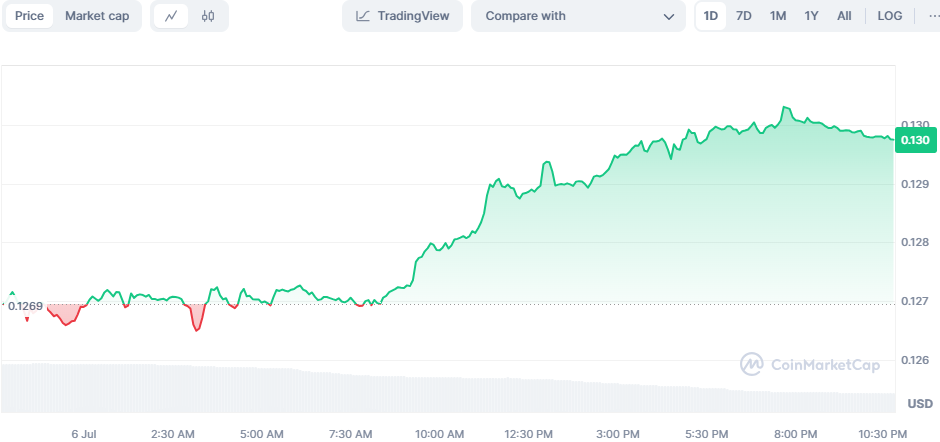
Amid this announcement, the TRON (TRX) price has been bullish in the last 24 hours after support was established at the intra-day low of $0.1265. Bulls consequently surged the price to an intra-day high of $0.1303 before facing resistance. At press time, TRX price was trading at $0.1299, a 2.50% surge from the intra-day low.